COBRA vs Individual Health Insurance Comparison: What To Know

Your benefits portal doesn’t email you a strategy. It just shuts off.
One day you’ve got a deductible you’ve been chipping away at all year and a doctor who knows your chart cold. The next day HR hands you a packet saying you can keep it all, for a price nobody warned you about.
That’s the real starting point for a COBRA vs individual health insurance comparison. Not a spreadsheet exercise. A decision made under pressure, with a 60-day clock already running and the people who benefit from your confusion staying quiet about it.
We’re The Benefits Boss, and we built this business on shopping every major carrier in the country so people aren’t stuck guessing at health insurance after job loss. Here’s what actually happens to your coverage, your wallet, and your deductible when the job ends, and the parts most people never get walked through until it’s too late.
Key Takeaways
- COBRA keeps your exact old plan, but you pay up to 102 percent of the full premium yourself
- Individual coverage resets your deductible to zero, even if you’d already paid most of it down
- The 2026 subsidy cliff means no ACA tax credit at all above 400 percent of the federal poverty level
- You have 60 days from losing coverage to decide, and the clock starts before your old plan even ends
COBRA vs Individual Health Insurance: What Changes When Your Job Ends
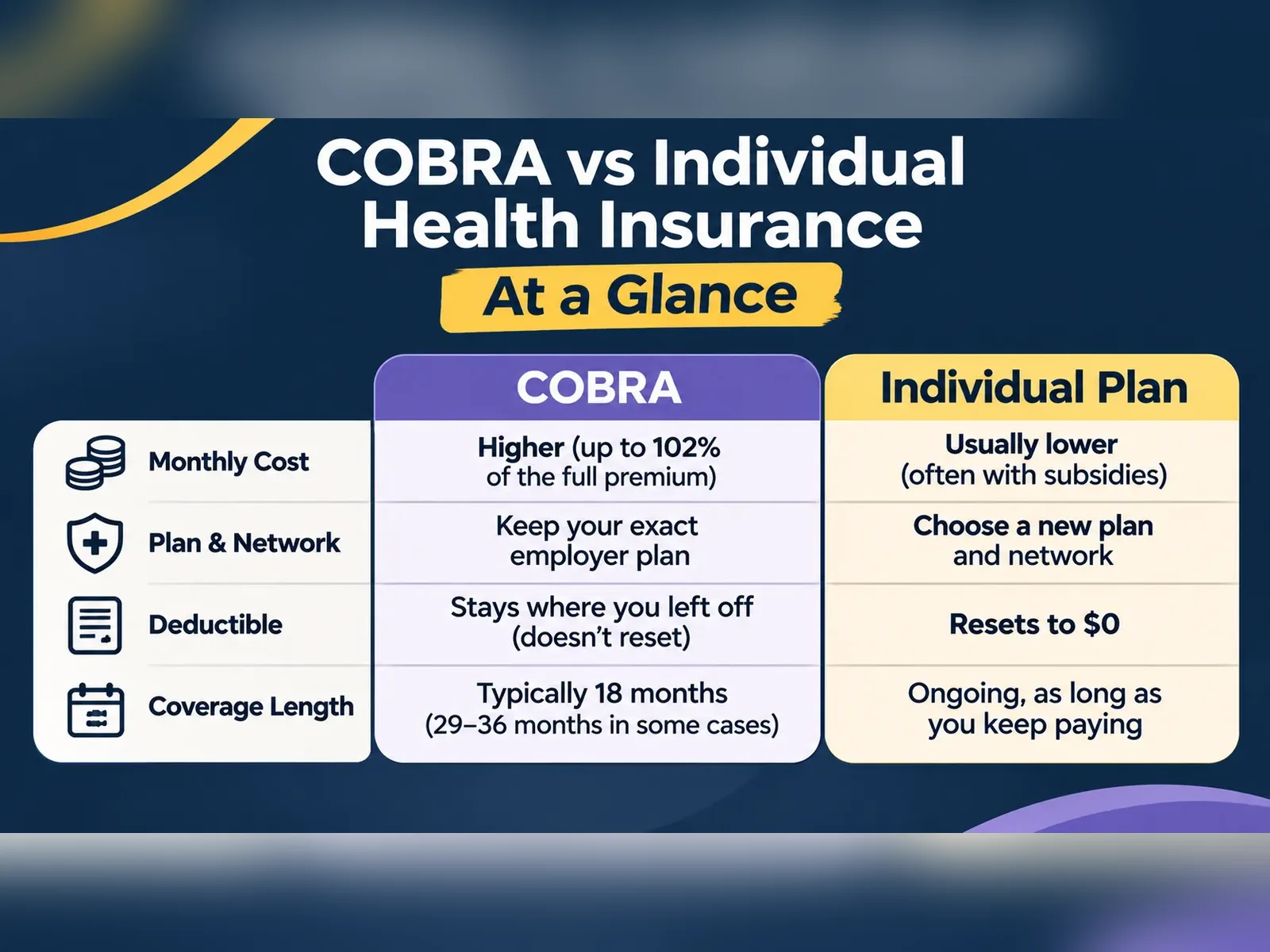
COBRA keeps the plan you already have. Individual coverage replaces it with something new. That’s the whole hinge this decision swings on.
COBRA continues your exact group plan: same deductible, same network, same prescription formulary, just without your employer picking up part of the bill anymore. Individual coverage, through the ACA Marketplace or directly from a carrier, starts from zero on all of it.
Every dollar, every deadline, and every network question in this COBRA vs individual health insurance comparison traces back to that one difference. Keep it in mind as you read the rest of this, because it explains almost everything that follows.
What Is COBRA Continuation Coverage
COBRA stands for the Consolidated Omnibus Budget Reconciliation Act. Despite how often people use it as shorthand for a type of plan, it isn’t insurance at all.
It’s a federal law that gives you the right to keep your employer’s group plan running under your own name after a qualifying event ends your active coverage. Job loss, a cut below the hours threshold that defines benefits eligibility, divorce, the death of the covered employee, or a dependent aging out all count.
Federal COBRA applies to employers with 20 or more employees. Worked for a smaller company? Don’t assume you’re excluded. Most states have mini-COBRA laws extending similar rights, though the length and cost rules vary enough that it’s worth checking your specific state before ruling it out.
This is the structure everyone’s losing job-based health insurance decision starts from, whether they realize it or not.
How COBRA Pricing Really Works
Here’s what nobody explains at the exit interview. Your employer was covering 70 to 80 percent of your premium the entire time you worked there, and that line item vanishes the moment you go on COBRA.
You now pay the full premium yourself, employer’s share included, plus a 2 percent administrative fee. That caps your bill at 102 percent of total cost, or 150 percent during a disability extension.
In real numbers, a plan that cost you 180 dollars a month as an employee can easily become 600 to 900 dollars a month on COBRA. Family coverage climbs well past that.
Check your severance agreement before you assume anything. Some employers quietly cover COBRA premiums for a set window after you leave, and that detail changes this entire calculation.
How Long COBRA Coverage Lasts
COBRA isn’t indefinite, and that’s by design. The standard window runs 18 months for job loss or reduced hours.
It extends to 29 months if the Social Security Administration determines a qualified beneficiary disabled, and up to 36 months for a second qualifying event like divorce or a dependent losing eligibility.
You get 60 days to elect coverage once it’s offered. Your first payment isn’t due for 45 days after that, and it’s retroactive, so there’s no actual gap in care, just a gap in paying for it.
Treat COBRA as a bridge, not a destination. That built-in expiration date is exactly why the next section matters.

What Is Individual Health Insurance
Individual coverage means buying a policy directly, either through the ACA Marketplace or off-exchange from a private carrier, instead of continuing whatever your employer offered.
It’s not a lesser version of your old plan. It’s a different policy entirely, with its own network, its own deductible, and its own drug formulary.
Which lane you land in, Marketplace or private, comes down mostly to income and subsidy eligibility. Knowing which one applies to you before you start shopping saves a lot of wasted comparison time later.
ACA Marketplace Plans
Marketplace plans run on premium tax credits calculated from your projected annual income, not your old salary. That’s exactly why someone who just lost a job can unlock a subsidy they never got through their employer plan.
2026 changed that math, though. The enhanced subsidies that ran from 2021 through 2025 expired, bringing back the 400 percent federal poverty level subsidy cliff for the first time in years.
Above that line, roughly 62,600 dollars for an individual or 128,600 dollars for a family of four, there’s no premium tax credit at all. Full price, no exceptions.
Every ACA Marketplace plan still guarantees the ten essential health benefits and covers pre-existing conditions with no underwriting questions, which matters if you’re shopping with any kind of health history. You can compare real Marketplace options for your state before assuming what you’ll pay.
Private Health Insurance Plans Outside the Marketplace
Private plans come straight from a carrier, no exchange, no income-based subsidy attached.
For a lot of people that sounds like a downgrade. For higher earners already above the subsidy cliff, it’s often the stronger move.
With no subsidy left to protect, you’re free to shop purely on plan design. Private health insurance frequently comes in cheaper than COBRA for healthy applicants, with more flexibility in how the plan itself is built.
We work with every carrier in the country specifically so this part of the comparison doesn’t start and end with whatever one insurer happens to quote you first. See what’s actually available outside the exchange before you rule it out.

COBRA vs Individual Health Insurance: Comparing the Real Monthly Cost
This is where the comparison earns its keep.
COBRA for individual coverage typically runs 600 to 900 dollars a month once you’re covering the full premium plus the administrative fee. Family coverage climbs well past that range.
Individual coverage has no fixed number. It swings entirely on projected income and subsidy eligibility, which means two people in nearly identical situations can see wildly different quotes depending on how the rest of their year shapes up financially.
Cheaper isn’t a fixed answer here. It depends on numbers that are different for every person reading this, which is exactly why guessing is the expensive move.
The Deductible Reset Nobody Talks About
Almost nobody weighs this correctly, and it’s often the single biggest factor in the entire decision.
COBRA keeps you inside the same plan year, so any progress you’ve made toward your deductible and out-of-pocket maximum carries over untouched. Switch to a new individual plan, and both reset to zero, no matter how close you were to clearing them.
Picture someone three months into a 6,000 dollar deductible who’s already paid 4,000 dollars toward it. Moving to a new plan erases that progress completely, even if the new premium looks great on paper.
If you’re mid-treatment or expecting a procedure this year, run the full math through our out-of-pocket estimator before deciding anything based on premium alone.

What Happens If You Earn Too Much for an ACA Subsidy
Most health insurance content skips this question entirely, and it’s exactly where a lot of our clients sit.
Above 400 percent of the federal poverty level, the Marketplace offers you nothing. No tax credit, no discount, full sticker price regardless of how affordable it looked for someone else.
Severance pay and a working spouse’s income both count toward that threshold. You can cross the line without realizing it until the quote comes back far higher than expected.
Why Self-Employed Professionals and Early Retirees Feel This Most
Self-employed professionals with strong 1099 income and early retirees living on savings or non-wage income hit this ceiling constantly, often without expecting it.
For both groups, the subsidy cliff flips the entire decision. There’s no discount left to protect by staying inside the exchange.
This is exactly where off-exchange plans get competitive again, and it’s the client profile we work with most: someone past subsidy range who needs a plan built around their actual doctors and a real budget, not an income bracket.
The 60-Day Special Enrollment Period You Can’t Miss
Both COBRA and Marketplace enrollment run on a 60-day window, starting 60 days before your old coverage ends and continuing 60 days after.
That means you can line up new coverage before your job-based plan even lapses, with zero gap in care. It sounds generous until a layoff, severance negotiation, and a job search are all happening at the same time.
Miss that window without another qualifying event, and you’re stuck waiting for the next open enrollment period. HealthCare.gov confirms this timeline applies no matter which path you’re leaning toward, so mark the date the moment you know your coverage end date.
When Keeping COBRA Actually Makes Sense
COBRA isn’t the wrong answer by default, and treating it that way misses real situations where it’s clearly the smarter move.
Mid-treatment with a specialist who knows your case. Already close to clearing your deductible for the year. Confident a new job with benefits is weeks away. An employer quietly covering part of your COBRA premium through severance.
Any one of these can make keeping what you already have beat starting over. This is a continuity-of-care decision as much as it’s a cost one, and sometimes continuity wins outright.

When Switching to a Private or Marketplace Plan Makes Sense
The flip side matters just as much.
COBRA’s premium is unsustainable. You’re early in a fresh deductible year anyway. You’re newly self-employed or retiring and need something built to last longer than 18 months. You’re healthy with no network worth protecting.
Any of those, and shopping COBRA alternatives usually wins. Switching doesn’t mean settling for less. A well-matched private or Marketplace plan can match, or beat, your old coverage once you stop defaulting to whatever feels familiar.
Can You Switch From COBRA to an Individual Plan Later
Electing COBRA today doesn’t lock you in forever.
You can drop it voluntarily later and move to an individual plan during the next open enrollment period or a qualifying event of your own. Here’s the catch almost nobody mentions: voluntarily dropping COBRA outside of open enrollment doesn’t, by itself, create a new special enrollment period.
Time this wrong, and you can end up without coverage options for months. This is exactly the kind of timing question worth a real conversation instead of a guess.
Common Mistakes People Make After Losing Job-Based Health Insurance
Most of the expensive mistakes here aren’t about bad math. They’re about not running the comparison at all.
Assuming COBRA Is the Only Option
A huge number of people elect COBRA simply because it shows up first and requires zero research, not because anyone actually compared it against individual coverage.
That default costs real money for a lot of people, especially above the subsidy cliff where the right answer genuinely isn’t obvious in either direction. Our two-minute plan quiz at least points you toward which direction to start digging.
Ignoring the Deductible Reset
People compare premiums side by side and forget the deductible resets until a medical bill shows up and the math suddenly looks completely different.
The plan that looked cheaper on the quote isn’t always cheaper across the full year. Factor the reset in before you sign anything, not after.
Get a Personalized Plan Comparison From The Benefits Boss
Everything above proves one thing: this decision depends on your income, your timing, and your health needs, not a one-size answer from a blog post.
We shop every major carrier in the country, charge $0 brokerage fee to you, and build a plan around your actual doctors and prescriptions instead of a generic quote. Over 1,000 people have left us five-star reviews after making this exact decision with us.
Book a free consultation and we’ll run your real numbers together, today.
Written by Marco
Licensed Coverage Advisor at The Benefits Boss